
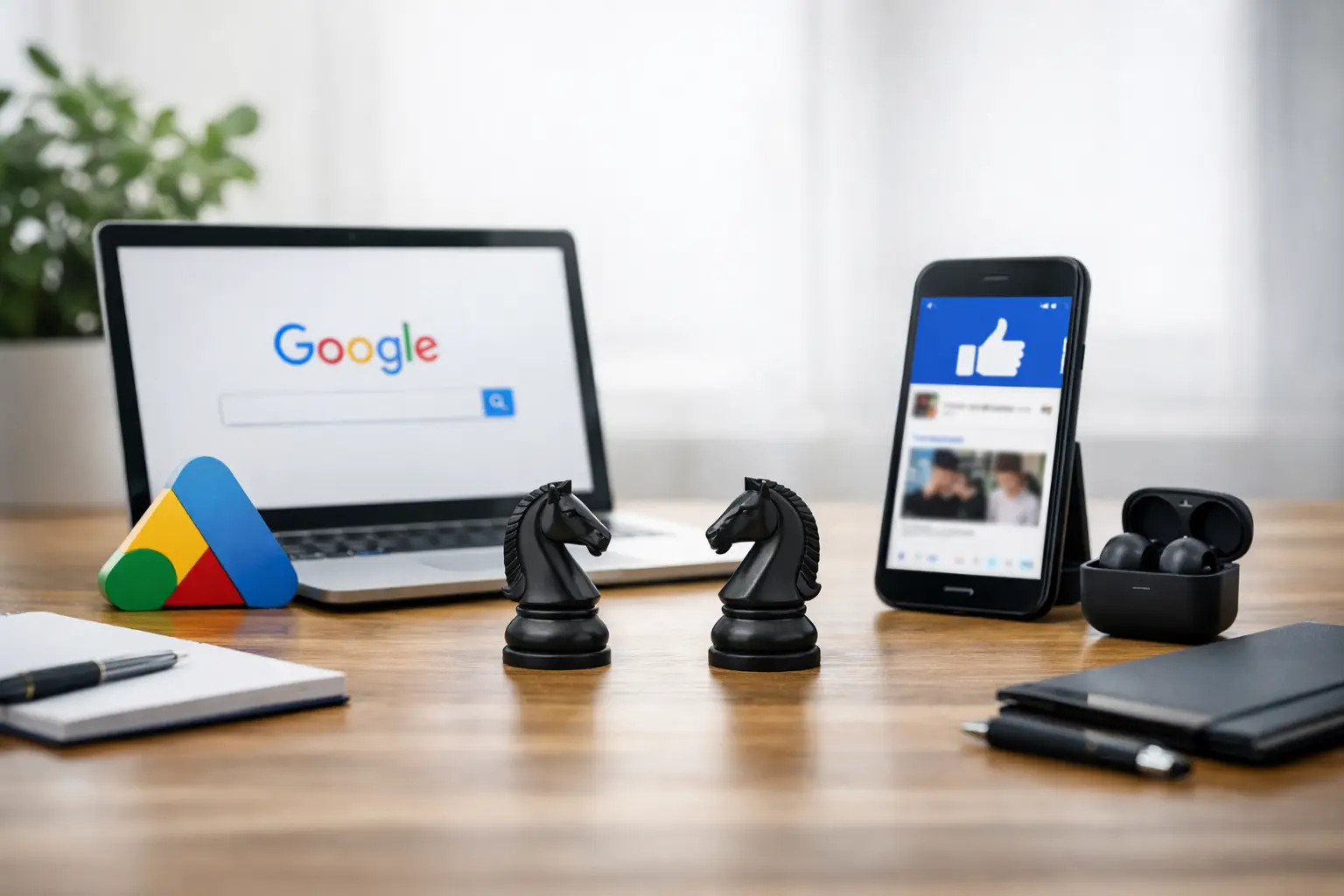
A plumbing business with an emergency call-out service and a new skincare brand can both advertise online, but they should not expect the same channel to produce the same result. The Google Ads vs Facebook Ads decision comes down to what people are doing when they see your ad: actively looking for help, or being introduced to an offer while scrolling.
For small to mid-sized businesses, that distinction affects lead quality, budget, creative requirements and how quickly advertising can contribute to revenue. Google Ads and Facebook Ads, now managed through Meta’s advertising platform, can both be valuable. The better choice is rarely about which platform is universally cheaper. It is about which one matches your customer’s buying process and your commercial goal.
Google Ads vs Facebook Ads: the key difference
Google Ads captures existing demand. A person searching “commercial electrician Brisbane”, “family lawyer near me” or “buy office chairs online” already has a need and is taking a step towards solving it. Search campaigns place your business in front of that person at a high-intent moment.
Facebook Ads creates or develops demand. People generally use Facebook and Instagram to catch up, watch content, browse local businesses and discover products. Your ad needs to interrupt that activity with a message, image or offer compelling enough to earn attention.
This is why search advertising often produces more immediate enquiries for service businesses, while Facebook Ads can be highly effective for visual products, promotions, events, lead nurturing and reaching audiences before they begin searching. Neither platform is automatically better. Intent is the deciding factor.
When Google Ads is likely to deliver better results
Google Ads is a strong fit when your customers know what they need and search for it directly. This commonly applies to trades, professional services, health providers, automotive businesses, B2B suppliers, urgent repairs and many local services.
A well-managed search campaign lets you target keywords that signal commercial intent. For example, “tax accountant Brisbane” is much closer to an enquiry than a broad social media audience interested in finance. You can also control geography, operating hours, device targeting and the pages people land on after clicking. For a local business, this means budget can be directed towards people within practical service areas rather than broad awareness.
The main advantage is speed from search to action. If someone needs a locksmith at 9 pm, a clear ad, a credible landing page and an easy phone call option can produce a lead within minutes. This makes Google Ads particularly useful where the value of a new customer is high enough to support competitive click costs.
However, Google Ads is not a shortcut around weak positioning. If your website is slow, your quote process is unclear or competitors have stronger reviews and offers, paying for clicks will not solve the underlying issue. Search campaigns also depend on sufficient search volume. A very specialised service may have limited keyword demand, even if each lead is valuable.
Costs on Google Ads
Google Ads costs vary significantly by industry, location and keyword competition. Legal, finance, insurance, medical and some trade categories can attract expensive clicks because a single client is worth substantial revenue. A lower cost per click is not necessarily a better result if those clicks do not convert into genuine enquiries.
The more useful measures are cost per qualified lead, lead-to-sale rate and customer value. A campaign that produces a $120 lead may outperform one producing a $35 lead if the first delivers customers who are ready to proceed and spend more.
When Facebook Ads can be the smarter investment
Facebook and Instagram advertising is often more effective when your offer benefits from visual presentation, storytelling or repeated exposure. Retail, beauty, fitness, hospitality, property, education, home improvement and lifestyle businesses can use creative to show the outcome customers want, rather than relying on a search query.
It is also useful when potential customers do not yet realise they need your service. A business selling ergonomic office furniture, for instance, may reach owners and managers with content about workplace comfort and productivity before they search for a supplier. An allied health clinic may promote a useful guide or introductory offer to build familiarity with people in its local area.
Meta’s audience tools allow campaigns to target locations, demographic groups, interests and engagement behaviours. You can also remarket to people who visited your website, watched a video or engaged with your social content. This creates practical opportunities to stay visible while customers compare options and take time to decide.
The trade-off is that a social media lead is not always ready to buy. A form completion can reflect curiosity, not genuine demand. Businesses need a clear follow-up process, realistic lead qualification and reporting that separates enquiries from booked jobs or sales.
Costs on Facebook and Instagram
Facebook Ads can deliver lower-cost clicks and leads than Google Ads, especially for awareness or simple lead-generation campaigns. But low cost can be misleading. An ad offering a free quote may attract a large number of submissions, including people outside your service area, customers with unsuitable budgets or people who do not answer follow-up calls.
Creative fatigue is another consideration. Social ads need fresh images, video, copy and offers more regularly than search campaigns. An ad that performs well in its first few weeks can lose effectiveness once the same audience has seen it repeatedly. This requires active management rather than a set-and-forget approach.
Compare the platforms by your business objective
The right channel becomes clearer when the objective is specific. If your priority is urgent phone enquiries, Google Search is usually the starting point. If you want to launch a new product, build awareness in a defined area or generate demand for a service people rarely search for, Facebook and Instagram may be more suitable.
For online retailers, Google Shopping can capture people already comparing products, while Facebook and Instagram can introduce a collection, promote a seasonal offer and bring previous visitors back to the site. Using both can be more effective than treating the platforms as competitors.
For longer sales cycles, such as commercial services, construction, consulting or high-value home projects, a combined approach is often sensible. Facebook Ads can build recognition and provide useful educational content early in the journey. Google Ads can then capture high-intent searches when prospects are ready to shortlist providers. Remarketing helps maintain visibility between those stages.
Budget matters, too. A modest budget spread across too many campaign types usually produces inconclusive data. It is often better to begin with one channel, one clear offer and strong conversion tracking. Once results are stable, a second channel can be added to support a proven strategy.
What should be measured beyond clicks and impressions
Clicks, reach and impressions show activity, but they do not prove business growth. The reporting that matters should connect advertising to meaningful actions: phone calls, qualified forms, booked appointments, online sales, quote requests and revenue where possible.
Before launching either platform, make sure the website gives people a logical next step. A search ad for a specific service should lead to a page about that service, with clear proof of capability, service areas, contact details and a straightforward call to action. A Facebook campaign needs a matching message from ad to landing page. If the ad promises a consultation, the form and follow-up should make booking one simple.
Tracking also needs to reflect how customers actually enquire. Many Australian service businesses receive leads by phone, web form, email and sometimes in person. Google Analytics, call tracking and CRM data can help identify which campaigns create opportunities that turn into paying work, not just digital activity.
A practical way to choose your first channel
Start with three questions. Are people actively searching for what you sell? Can you describe a strong offer that will stop the right audience mid-scroll? And can your team respond promptly when an enquiry arrives?
If search demand is clear and customers usually need a provider now, prioritise Google Ads. If your business needs to create awareness, demonstrate a visual transformation or build an audience over time, test Facebook and Instagram. If both statements are true, use the channels for their different jobs instead of expecting one campaign to do everything.
DigiMedia Worx approaches paid advertising as part of a wider growth plan, not as a standalone spend line. That means considering search demand, website conversion paths, tracking, lead quality and the capacity of your business to follow up. Transparent reporting should make it clear what is working, what needs adjustment and where the next dollar is most likely to produce a return.
The strongest next step is not choosing a platform based on a headline cost per lead. Choose the channel that reaches the right customer at the right stage, then measure whether those enquiries become profitable customers.